One of the most common welding blanket inquiries we receive looks like this:
“Please quote 100 welding blankets, size 6 × 8 ft.”
That is enough to begin a conversation, but not enough to calculate a reliable price.
We still need to know which side is 6 ft, whether the quoted dimensions are required before or after sewing, how the blanket will be installed, what kind of welding debris it will receive, whether a center seam is acceptable and where the grommets must be placed.
These details are not minor production preferences. They determine the fabric, the cutting plan, the amount of material consumed, the sewing method and sometimes whether the proposed blanket is suitable for the job at all.
This guide explains what we normally need before preparing a custom welding blanket RFQ for an OEM, distributor or industrial project.
BSTFLEX supplies industrial welding blankets, finished custom products and welding blanket rolls and roll goods for fabricators, safety-product distributors and private-label programs.
Many buyers begin by naming a material:
“We need a silica blanket.”
“Please quote your heaviest fiberglass blanket.”
“We need a 1000°C welding blanket.”
Material and temperature are important, but we first need to understand what will actually happen to the blanket.
A textile hanging beside a welding station does not experience the same load as a blanket lying under plasma cutting. In the first case, sparks may touch the surface briefly and fall away. In the second, slag can land in one place and continue transferring heat.
For an initial review, the following information is usually more useful than a maximum-temperature number:
Photos are useful. A marked sketch is even better when the blanket must fit around equipment, pipes, brackets or existing attachment points.
There is no single “best” welding blanket material. Each construction solves a different problem.
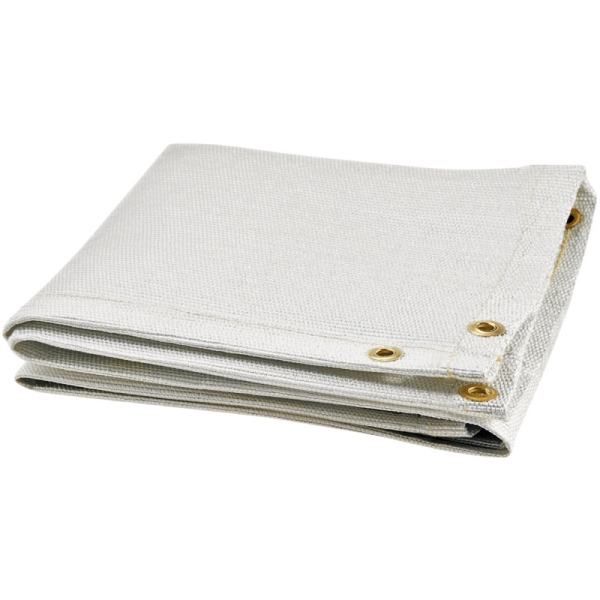
Heat-cleaned fiberglass is often the first material we review for economical, general-purpose spark protection.
It is flexible, uncoated and suitable for customers that want to cut or sew the material locally. It is commonly used for routine workshop barriers, temporary covers and finished blankets where severe slag exposure is not expected.
BSTFLEX supplies Heat Cleaned Fiberglass Welding Blanket Roll as well as finished fiberglass blankets.
Acrylic coating does not simply turn fiberglass into a higher-temperature fabric. Its value is mainly in the surface.
The treatment helps stabilize the weave, reduces exposed fibers and improves handling during cutting, sewing, folding and repeated installation.
For general industrial use where plain fiberglass wears too quickly, Acrylic Coated Fiberglass Welding Blanket Roll can be a practical next step.
Finished products are also available as Acrylic Coated Fiberglass Welding Blankets.
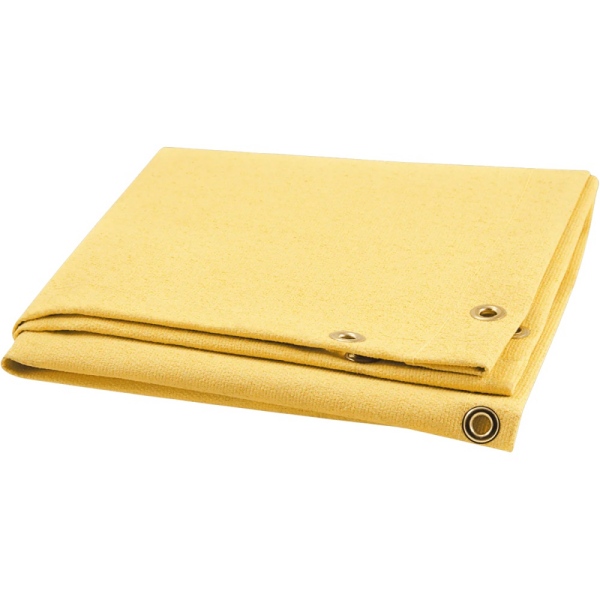
Silicone coated fiberglass is normally considered when the blanket will be handled frequently or exposed to moisture, oil and ordinary workshop contamination.
The coated surface is smoother and easier to clean than exposed fiberglass. It also offers improved abrasion resistance.
The silicone and the fiberglass are still two different materials. A temperature associated with the fiberglass yarn should not automatically be used as the working temperature of the complete coated product.
For a finished construction, see the Silicone Coated Fiberglass Welding Blanket.
Vermiculite is a mineral treatment rather than a rubber coating.
We normally review this material when the application is more demanding than routine spark protection and the customer needs a heavier construction with improved thermal and surface performance.
BSTFLEX offers Vermiculite Coated Fiberglass Welding Blanket Roll in several weights and thicknesses.
Silica becomes relevant when sustained thermal exposure is beyond the range normally addressed by standard fiberglass constructions.
The term “silica” is not enough for a production specification. The silica content, fabric weight, thickness and finished construction still need to be agreed.
BSTFLEX manufactures Silica Fabric Welding Blankets for welding, cutting and industrial maintenance applications.
Silicone coated silica combines a high-temperature textile base with a coated surface.
It can be useful where thermal performance and repeated handling are both important. The coating limit, however, remains separate from the capability of the silica cloth underneath.
See the Silicone Coated Silica Welding Blanket.
Aluminized fiberglass is mainly used when radiant heat is the problem.
The reflective side should face the radiant heat source. A reflective surface is not automatically the best surface for heavy direct slag contact.
See the Aluminized Fiberglass Welding Blanket.
Carbon felt is soft and conformable, which makes it useful around pipes, irregular machinery and localized repair areas.
Open-air welding performance must be considered separately from carbon-felt temperature figures quoted for vacuum or inert-atmosphere furnace applications.
See the Carbon Fiber Felt Welding Blanket.
A broader comparison is available in Welding Blanket Materials: Fiberglass, Silica, Silicone, Aluminized and Carbon Felt.
A coated fabric may be quoted as 800 g/m², but that figure can mean several things.
It may be:
Two suppliers can both offer an 800 g/m² product while using different base fabrics and different coating amounts.
For repeat production, we recommend recording at least:
| Item | Why It Matters |
|---|---|
| Base Fabric Weight | Shows how much fiberglass, silica or other textile is present before coating |
| Finished Coated Weight | Shows the total mass after the surface treatment has been applied |
| Thickness | Affects flexibility, bulk, sewing and thermal separation |
| Coating Type | Changes surface behavior and working conditions |
| Coating Side | Important where one side and two sides are different constructions |
Weight and thickness should not be used as substitutes for each other. A texturized fabric may be thicker than a compact filament fabric even when their weights are similar.
The heaviest option is also not always the most practical. A very heavy blanket can become difficult to hang, fold, store and ship.
Temperature data is another area where quotations can become misleading.
The base fiber, coating, laminate, thread and finished assembly may all have different thermal limits.
For example, fiberglass may retain its structure at a temperature that is already too high for an acrylic or silicone coating. A foil-facing system may also have a lower composite working limit than the fiberglass underneath it.
A useful RFQ separates:
For further guidance, see High Temperature Welding Blankets: Temperature Ratings and Material Selection.
A blanket described as 6 × 8 ft can still be made incorrectly if the order does not identify which side is the top.
The same dimensions installed 6 ft wide × 8 ft high require a different grommet pattern from a blanket installed 8 ft wide × 6 ft high.
The purchase order should also state whether the dimensions apply before or after sewing.
A clear instruction would be:
Finished size after sewing: 2000 mm wide × 3000 mm high. The 2000 mm edge is the top.
This removes several common uncertainties at once.
A 6 × 6 ft blanket measures 1828.8 × 1828.8 mm. It is not exactly the same as an 1800 × 1800 mm blanket.
Likewise, 10 × 10 ft is 3048 × 3048 mm, not 3000 × 3000 mm.
Use one unit as the controlling dimension. The converted figure can be shown for reference.
Finished blanket width and raw material width are not the same thing.
If a customer needs a 2 m wide blanket but the selected fabric is approximately 1 m wide, the normal production route is to join two or more panels.
This needs to be agreed before the sample is made.
Useful questions include:
“Custom size” does not automatically mean seamless construction.
Buyers often approve the fabric but leave the sewing details open.
This can create inconsistency between samples and repeat production.
An edge may be:
The best method depends on the material. A woven fiberglass cloth, heavy silica fabric and carbon felt do not necessarily use the same finish.
The sewing thread also needs attention. Ordinary textile thread should not be substituted into a high-temperature blanket without approval.
For repeat OEM production, record:
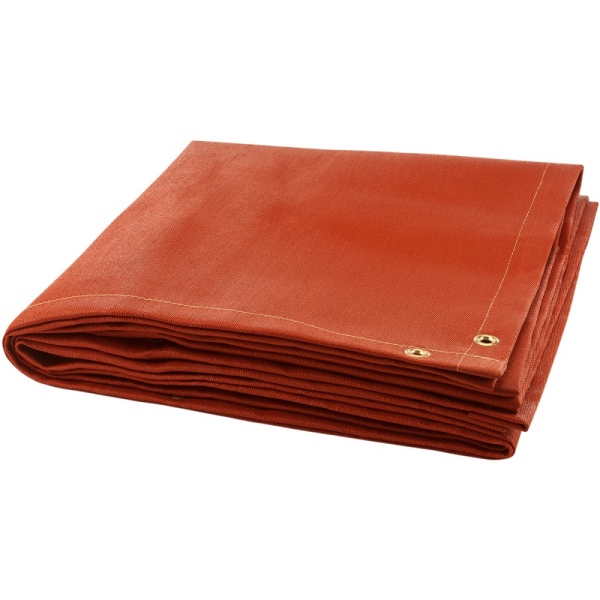
“Grommets every 18 inches” sounds clear, but it still leaves several questions unanswered.
Is the distance measured center to center? Where is the first hole placed? Should the final interval be shorter? Are the grommets required only along the top edge or around the whole perimeter?
A complete welding blanket with grommets specification includes:
| Item | Information Required |
|---|---|
| Material | Brass, stainless steel or another agreed metal |
| Inside Diameter | Clear opening required for the hook, cable or fastener |
| Location | Top edge, corners, selected sides or all four sides |
| Pitch | Exact center-to-center spacing or maximum permitted spacing |
| Edge Offset | Distance from the hole center to the finished edge |
| Corner Offset | Distance from the first and last holes to the corners |
| Reinforcement | Local patch or continuous reinforced border |
If the blanket must fit an existing frame, a dimensioned hole-location drawing is safer than a general spacing note.
A fabric sample can confirm the surface, color and approximate thickness. It cannot approve the finished blanket.
The finished product also includes:
For a new OEM welding blanket, a finished pre-production sample is usually the most reliable approval method.
Once approved, keep the following together:
This becomes the golden sample for future orders.
A photograph alone is not enough to control fabric weight, coating amount, thread or internal construction.
A private-label project often includes more than adding a logo.
Possible requirements include:
Any certification mark or compliance wording must be supported for the exact construction. A mark should not be added because a similar fabric has a test report.
Packaging also affects cost and handling.
A large, heavy welding blanket may need a different carton quantity from a lightweight fiberglass blanket. Putting more pieces in one carton is not always better if the carton becomes difficult to lift or damages the product during transport.
State whether the blanket should be folded, rolled, individually bagged or packed in bulk. For distributor programs, carton dimensions, gross-weight limits and pallet configuration can be agreed before production.
The following example is specific enough for a manufacturer to review, while still allowing the material to be proposed by the factory.
| RFQ Field | Example |
|---|---|
| Product | Custom finished welding blanket |
| Application | Vertical protection beside maintenance welding |
| Exposure | Sparks and moderate welding spatter; no sustained molten-metal pooling expected |
| Material | Manufacturer to recommend suitable fiberglass-based construction |
| Finished Size | 2000 mm wide × 3000 mm high after sewing |
| Orientation | The 2000 mm edge is the top |
| Panel Seams | Supplier to show proposed seam locations before sample approval |
| Edges | Reinforced hems on all four sides |
| Grommets | Top edge only; locations according to attached drawing |
| Label | Customer part number and finished size |
| Packaging | One blanket per bag; agreed quantity per export carton |
| Sample | One finished pre-production sample required |
| Quantity | Initial order and annual forecast stated separately |
Product: Custom welding blanket / welding curtain / roll material
Application: [welding, cutting, grinding, brazing, maintenance or other]
Exposure: [sparks, spatter, slag, radiant heat, direct contact or combination]
Installation: [horizontal, vertical, draped, wrapped or framed]
Protected item: [floor, machinery, painted surface, cable, hose or other]
Normal temperature: [value or unknown]
Peak temperature and duration: [value, duration or unknown]
Preferred material: [material or manufacturer recommendation]
Base fabric weight: [g/m², oz/yd² or manufacturer recommendation]
Finished coated weight: [required value or manufacturer proposal]
Thickness: [required value, range or manufacturer proposal]
Coating: [uncoated, acrylic, silicone, vermiculite, aluminized or other]
Finished dimensions: [width × length after sewing]
Panel seams: [acceptable / not acceptable / drawing required]
Edge construction: [hemmed, bound, reinforced or manufacturer proposal]
Grommets: [material, diameter, pitch, edge offset and drawing]
Quantity: [sample, first order and annual forecast]
Branding: [BSTFLEX, neutral, OEM or private label]
Packaging: [bag, carton quantity and pallet requirements]
Documents: [TDS, test report, inspection report or project requirement]
Delivery destination: [country, port or delivery address]
Provide the process, expected sparks or spatter, installation position, protected item, preferred material, weight or thickness, finished dimensions, seam restrictions, edge finish, grommet layout, quantity and packaging.
Yes. State the required finished dimensions after sewing and identify which edge is the top where orientation affects the grommet layout.
It depends on the available width of the selected fabric. Wider finished blankets may require joined panels. Seam locations should be agreed before sample production.
Yes. Supply the exact hole centers, inside diameter, edge offsets and grommet material on a dimensioned drawing.
Yes, when the construction must be controlled. For coated fabrics, also state whether the weight refers to the base fabric or the finished coated material.
Yes. Private-label programs can include product labels, part numbers, barcodes, instructions, cartons and pallet markings, subject to agreed quantities and specifications.
Yes. BSTFLEX supplies full rolls, cut-to-length fabric, cut panels and completed welding blankets.
Yes. A finished pre-production sample is recommended for new OEM products so the material, dimensions, seams, edges, thread, grommets, labels and packaging can all be approved.
Send BSTFLEX the application, expected exposure, installation method, preferred material, finished dimensions, seam restrictions, edge construction, grommet layout, quantity and packaging requirements.
If the material has not yet been selected, describe the welding or cutting process, sparks, spatter or slag, normal and peak temperature, blanket position and the item that must be protected.
BSTFLEX can review the application and prepare a proposed construction for sample approval and production quotation.
Browse the complete BSTFLEX Welding Blanket range, review Welding Blanket Rolls & Roll Goods, or send your custom welding blanket RFQ.

 English
 français
 Deutsch
 русский
 italiano
 español
 português
 Nederlands
 日本語
 한국의
 Türkçe
 Polski
 Tiếng Việt
 slovenský
 Indonesia